
- Details
Winnipeg is a beautiful place to live, I love it. And really not as crowded as many other cities with the same number of inhabitants. Of course that also may be a result of past… let’s say “miscalculations”.
When in the late 19th century Winnipeg was growing and growing, the general consensus was that Winnipeg was going to be the central hub for North America. Railways were planned, Union Station was big and powerful. Many government buildings were built with the future in mind, meaning “on the big side”. Roads, streets and avenues were large and comfortable enough to accommodate lots of traffic.
Then came August 15, 1914. The BLOW to Winnipeg’s future was given by the opening of the Panama Canal. Within a few weeks it was clear that Winnipeg would never become the big city that it had been designed for. Instead of 5 million people estimated, the number of inhabitants is now about 700,000. The better part of it is that rush hour only lasts 20 minutes.
From a photographic point of view there is a lot of interesting things from this glorious (to be) past. The Exchange district is full of old and interesting architecture, there are sky scrapers, although the sky in the beginning of the 20th century must have been a lot lower than today’s.
 Exchange district high-rise
An interesting “side effect” from staying a smaller city is that activities are blooming. Economical activities as well as cultural activities. Take the Festival du Voyageur or the Folklorama for example. Yesterday started the 41st Festival. The Folklorama is held in August. Lots of other activities are here to enjoy and to take pictures of.
- Details
The speed of light is the fastest you can find in nature, wherever you are looking. However you can catch elements that go at the speed of light, if you’re fast enough. Well, the only “thing” you can catch at the speed of light is of course light itself. Now that’s just what we’re doing in photography: catch the light.
To catch a bit more spectacular light we have to be fast, very fast. But signs of these events are there, sometimes long before the events occur.
 Tell-tale signs of upcoming thunderstorms
The signs I am talking about are of course cumulo-nimbus clouds, with the promise of some heavenly fireworks, a.k.a. thunderstorms.
- Details
“Quarrying at Stonewall began ca. 1880 as part of an emerging limestone industry in southern and central Manitoba. The Stonewall quarries were noted for their continuous production of various limestone-based construction materials. The quarries were long the economic mainstay of the town.
While ordinary building stone was taken in the early years of settlement, the more significant aspect of the Stonewall trade was to be the high quality quicklime produced in the kilns by burning limestone. The whiteness of this product placed it in demand for use in plasters. Commercial quarrying ceased in 1967 with the depletion of high quality reserves of Stonewall Formation limestone.”
This is the text on one of the commemorative plaques in the quarry of Stonewall. Now, what does this quarry look like? While I only have pictures from today, we may get an impression of the past. The quarry grounds are still there and have seen little change since the closure.
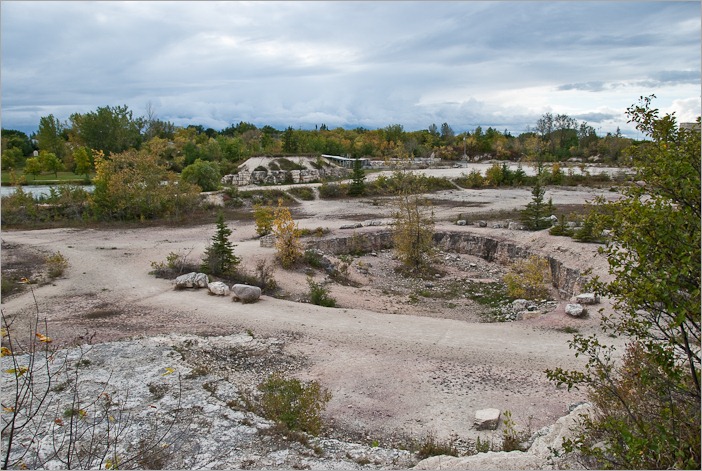 Overview of the quarry of Stonewall
The now barren ground of the quarry starts to get some growth, but nothing really wants to grow on these rocks. These were the places where the original limestone was taken. Right now, some places look like snake pits, but I didn’t spot any snakes. After the quarrying of stone came the more sophisticated quicklime. It had to be burned in ovens called kilns.
- Details
Water. World’s most common element. What would we be without it? Probably dried out. In photography, water also holds its place. Of course not only in the darkroom where the chemicals are mixed with water to obtain your film’s and paper’s images. It also exists far before the processing of your material.
Let’s go outside and forget about the darkroom. Too smelly anyway. In Winnipeg, we don’t have much time to contemplate open water, apparently the season is too short for this. Frozen water, yes, we know all about it. See Freezing Craftsmanship for this. We got lots of experience with that.
Now, liquid water is a whole different approach for photographers. Some people like the reflection of objects in the water, but what about the reflection of water in itself?
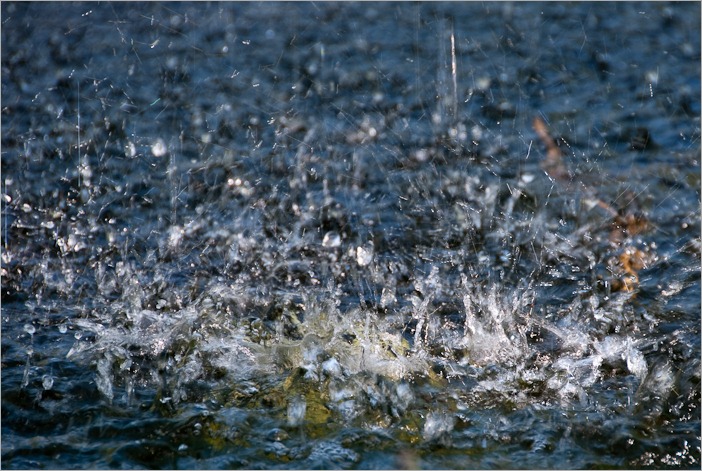 Water reflected in itself
That looks more like chaos to me. But nice and shiny. Here in Winnipeg, we have all kinds of quiet water, so I thought I’d start with something more wild.
- Details
Ah, life at night. Some people say that night sees things that sunlight does not support… By that, they mean criminals, vampires, or things they do not like to see themselves. Let’s leave it at that, shall we? The night life I am talking about here is about light. Night light and lighting for photographs. Lots of times we see things in the evening or at night, even in the early morning before sunrise and we say to ourselves: “Wow, that would be a nice picture!”. So, if we have our camera with us (we always have it with us, right?) we prepare to take THE picture.
Comes next morning. What is this picture in my camera? I never took a picture like that? I must have been drunk!. Ok, scrap that last remark, none of my business.
Our first object of choice: The moon. Hmmm. if your moon pictures look like this one,
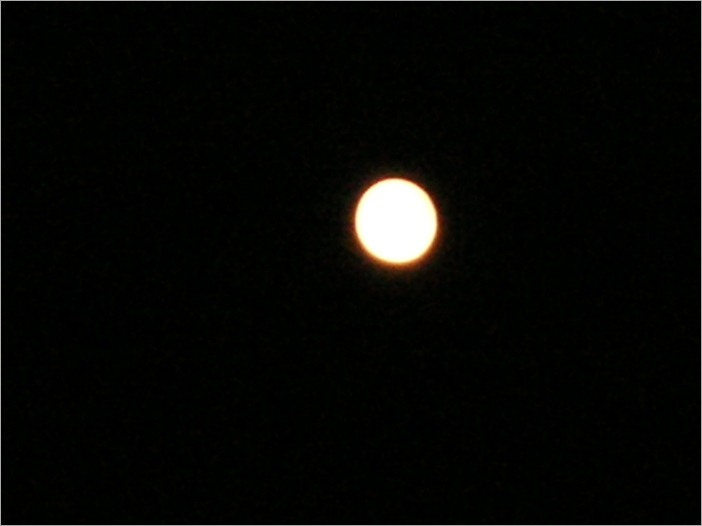 Definitely a moon picture, right?
perhaps, you should take a look at another post of mine called Blue moon. Better pictures will follow immediately :-) . The next target of choice is the fire pit in the garden. “Nothing to it”, yeah, right. Except that you will have to have a very steady hand taking the picture. And around a fire pit we mostly have had something to eat or drink that makes the hands not as steady as we think they are.
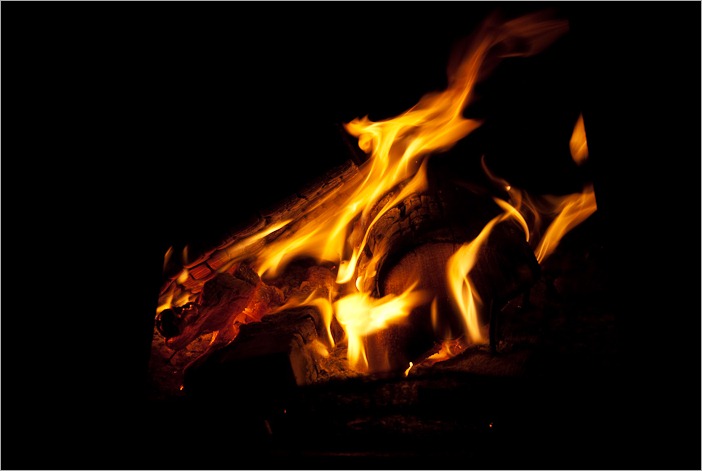 Handheld fire pit
So, we take the fire pit and hope for the best.
Ok, enough talk about missed pictures, how do we do this right? Let’s see…